
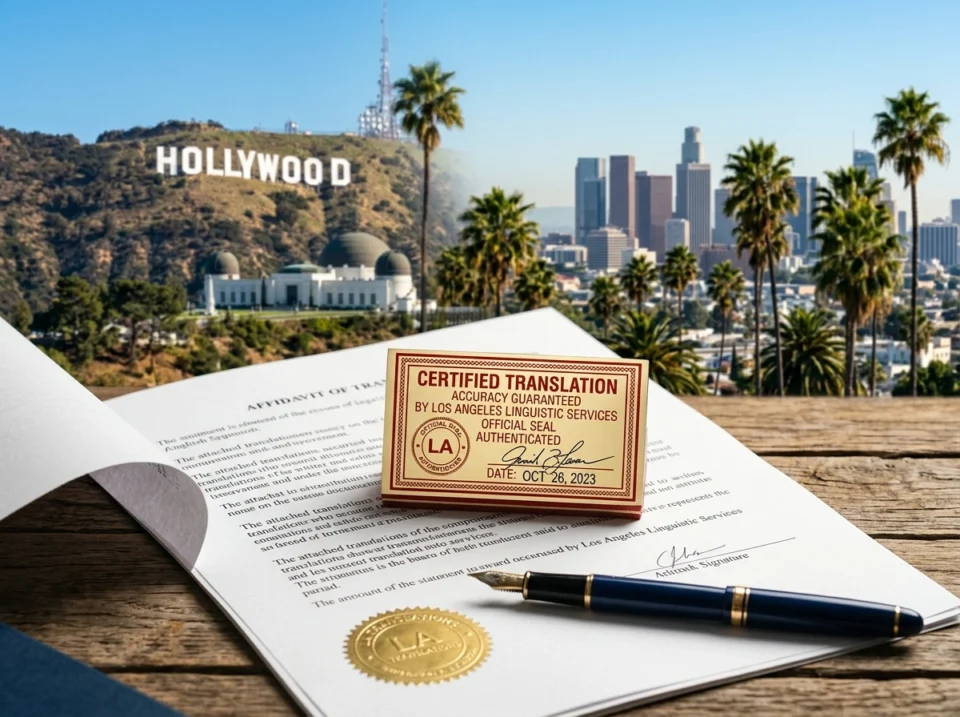
Los Angeles is one of the most culturally and linguistically diverse cities on the planet. With over 3.8 million residents speaking more than 224 languages, the city is a vibrant mosaic of global communities. From the bustling corridors of Koreatown and East LA to the international student hubs near Westwood, communication bridges the gap between countless cultures and essential civic institutions.
Navigating official processes in a multilingual metropolis often requires submitting foreign-language documents to English-speaking government agencies, courts, and universities. Submitting a simple, self-translated copy of a birth certificate or business contract is rarely enough. Institutions require a specific standard of proof to verify that the English translation matches the original foreign text perfectly.
Understanding these requirements can save you time, money, and significant frustration. This guide explains exactly what a certified translation entails, why it is critical for your official documents, and how to find the right professionals to handle your sensitive paperwork in Southern California.
What is a Certified Translation?
A certified translation is a formal document translated by a professional, accompanied by a signed Certificate of Accuracy. This accompanying certificate acts as a legal guarantee that the translation is a complete, exact, and accurate representation of the original document.
Unlike a casual translation you might get from a bilingual friend or an automated app, a certified translation is bound by strict institutional standards. The certificate must include the translator’s credentials, their contact information, a statement affirming their fluency in both languages, and a formal declaration of the translation’s accuracy.
For federal agencies like the United States Citizenship and Immigration Services (USCIS), this format is a strict requirement under federal regulations. A translation missing this signed certification will be rejected, regardless of how accurate the actual text might be.
Why Certification Matters for Legal and Official Documents
Submitting uncertified documents to government or legal bodies frequently results in immediate delays or outright rejections. When an agency processes your application, they need absolute certainty that the evidence provided is authentic. Certification provides that trust.
Consider the stakes involved in an immigration filing or a court case. A mistranslated word in a divorce decree or an omission in a police background check can alter the legal interpretation of your entire file. Certification holds the translator accountable and assures the reviewing officer or judge that no information has been altered, added, or lost in the linguistic transition.
Having a properly certified document ensures that your application moves forward smoothly. It eliminates the risk of receiving a Request for Evidence (RFE) from USCIS or having a judge dismiss your exhibits during a crucial hearing.
The Role of Professional Translators in Los Angeles
The extraordinary linguistic diversity of Southern California drives a constant demand for professional linguists. Translators in this region do much more than simply swap words from one language to another. They understand the complex legal and cultural nuances required by local authorities.
A professional linguist handling cases in LA knows the specific formatting preferences of the Los Angeles County Superior Court and the exact phrasing expected by university admissions boards. Relying on established translation services los angeles ensures your documents meet these localized and federal standards without a hitch. These experts provide translations across massive language pairs—from Spanish, Armenian, and Korean to Persian, Tagalog, and Amharic—reflecting the unique demographic makeup of the area.
Industries that Require Certified Translations
Different sectors maintain unique requirements for foreign-language documents. Here are the primary industries and institutions in Los Angeles that rely heavily on certified translations.
Immigration and USCIS
The Los Angeles USCIS Field Office and the Los Angeles Immigration Court process thousands of applications daily. Visas, green cards, naturalization packets, and asylum claims all require certified translations of foreign identity documents. Common materials include birth certificates, marriage licenses, and police records.
Courts and Legal Proceedings
Civil and family law cases at the Los Angeles County Superior Court frequently involve international documents. Whether attorneys are dealing with an overseas divorce, a child custody dispute, or international probate, all foreign-language evidence must be accompanied by a certified translation to be admissible in court.
University Admissions
Higher education institutions like UCLA, USC, and Caltech attract top talent from around the globe. International applicants must submit foreign academic transcripts, high school diplomas, and medical credentials. Admissions offices and credential evaluation services require certified translations to accurately assess a student’s academic background.
Employers and Human Resources
Major employers across the region—from Hollywood entertainment studios to massive healthcare networks like Cedars-Sinai—frequently hire international talent. Securing work authorizations like H-1B or O-1 visas requires translated employment contracts, foreign medical licenses, and academic records to prove the candidate’s qualifications.
DMV and Local Government
The California Department of Motor Vehicles (DMV) allows new residents to convert foreign driver’s licenses. They also handle vehicle titles and bills of sale for out-of-country vehicle registrations. The DMV strictly requires certified translations for any non-English documentation to process these requests.
How to Choose the Right Translation Service in Los Angeles
Not all translation providers are created equal. When selecting a partner to handle your sensitive paperwork, you must look for specific markers of reliability and professionalism.
First, look for providers associated with respected industry organizations, such as the American Translators Association (ATA). ATA-member translators uphold high ethical and quality standards.
Second, consider their turnaround times. Legal filings and immigration applications often operate on strict deadlines. A service that offers same-day or 48-hour turnarounds, along with rush mailing options, can be a lifesaver when a court date is rapidly approaching.
Finally, verify their acceptance guarantee. A reputable agency will explicitly state that their translations are formatted to be accepted by USCIS, local courts, and major universities. They should provide upfront pricing without hidden fees, allowing you to know the exact cost based on your document’s word count.
The Impact of Quality and Accuracy in Translation
Translation errors carry heavy consequences. A misspelled name, an incorrect date, or a misinterpreted legal clause can derail a person’s life. An inaccurate medical record translation could lead to dangerous credentialing mistakes for a healthcare worker, while a flawed business contract might result in costly litigation.
High-quality certified translations eliminate these risks. They preserve the integrity of the original text while making it perfectly clear to English-speaking officials. When you invest in accuracy, you are investing in peace of mind. You can submit your applications knowing that language barriers will not stand in the way of your goals.
Ensure Your Documents Are Accepted the First Time
Handling official paperwork is stressful enough without worrying about translation errors or rejected files. By securing professional, certified translations, you safeguard your most important applications and keep your plans on track.
If you are preparing documents for immigration, university enrollment, or a legal proceeding, take the time to find a trusted local partner. Reach out to a verified translation agency today to get a quote, understand their process, and take the next confident step in your official journey.
